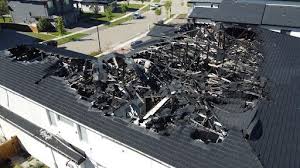
By almost any measure that matters to a roofer, 2025 was brutal. The United States absorbed an estimated $400+ billion in weather-related losses across tornadoes, hail, hurricanes, wildfires, and flooding — a figure that puts 2025 in the top three costliest disaster years on record, behind only 2017 and 2024. For the roofing industry specifically, the story was even starker: the National Insurance Crime Bureau and multiple carrier filings pointed to hail alone driving more than $30 billion in property damage claims, with the overwhelming majority tied to residential roofs.
That is not weather noise. That is a structural shift in what the business looks like. To understand what 2026 is likely to bring — and what smart roofing companies should be doing right now to prepare — we have to first understand what 2025 actually was.
The anatomy of a $400 billion year
Severe convective storms (the industry term for the thunderstorm complexes that spawn hail, damaging straight-line winds, and tornadoes) have quietly become the single largest driver of insured US property losses. Hurricanes grab the headlines; hail pays the claims. In 2025, insured losses from severe convective storms exceeded $70 billion, according to reinsurance industry estimates — the third consecutive year above that threshold and a near-doubling of the 10-year rolling average.
A few specific events did most of the damage:
- March 14–16, 2025 — Central US hail swarm. A multi-day severe-weather outbreak across Texas, Oklahoma, Arkansas, and Missouri produced more than 480 confirmed hail reports of 2 inches or greater. Dallas–Fort Worth alone saw baseball-sized hail in multiple northern suburbs on March 15, triggering what became one of the largest single-day roofing claim events in Texas history.
- April 27 — Tornado outbreak, Deep South. A long-track EF-4 plus dozens of smaller tornadoes across Mississippi, Alabama, and Georgia produced catastrophic damage along a 300-mile corridor. Insured losses topped $8 billion; roofing and siding accounted for the bulk of the residential claim volume.
- May 20 — Denver Metro mega-hail event. Hail up to 4.5 inches in diameter pounded a 40-mile swath from Aurora through northeast Denver. Early estimates put residential claims alone above $2.5 billion — the most expensive hail event in Colorado history.
- June 29 — Chicagoland derecho. A hurricane-force wind event crossed the Upper Midwest, knocking out power to more than 900,000 customers and producing widespread roof, fence, and siding damage from Iowa through northern Indiana.
- August–October — Atlantic hurricane season. A near-record Atlantic season delivered three major hurricanes (Category 3+) to the US coast between the Carolinas and the Panhandle. While the storm-surge losses dominated the headlines, inland wind damage drove tens of thousands of roofing claims as far north as Virginia.
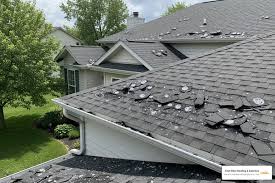
Where the damage concentrated
Spend 30 seconds looking at a 2025 hail-swath map and a pattern jumps out: the old “hail alley” (Texas, Oklahoma, Kansas, Nebraska) is no longer the whole story. The 2025 season saw the heaviest insured losses distributed across a much wider footprint:
- Texas — still #1 by a wide margin, but 2025 claims were heavily concentrated in North Texas (DFW metro, Collin County, Denton County) and the I-35 corridor down to Austin.
- Colorado — jumped to #2, almost entirely on the back of the May 20 Denver event and a series of smaller hail storms along the Front Range in June and July.
- Minnesota & Wisconsin — a much-more-active-than- normal season in the Upper Midwest, with repeated severe-weather outbreaks across the Twin Cities, Milwaukee, and Madison markets.
- Alabama, Mississippi, Georgia — the April tornado outbreak plus an active summer severe season pushed the Deep South into the top five claim-generating regions for the first time since 2011.
- Ohio Valley & Mid-Atlantic — the June derecho plus a string of wind events in September produced a claim surge across Ohio, Pennsylvania, Virginia, and the Carolinas.
The takeaway for roofers: if your company's chase playbook is still built around the same five metros it was in 2015, you are leaving volume on the table. The “where does it hail” map is actively redrawing itself.
What the insurance data says about repair cycles
One of the most useful 2025 data points for any roofing business is not a storm event at all — it is what the carriers quietly did about deductibles. Across Texas, Colorado, Oklahoma, and Kansas, several major homeowners carriers raised their wind/hail deductibles to either percentage-based (1–2% of dwelling coverage) or flat amounts of $2,500 and up. This matters because:
- Higher deductibles mean more homeowners choose not to file a claim for minor damage — which pushes repair demand toward cash jobs and insurance-ineligible work.
- Public adjusters and attorney-driven claim volume have risen sharply in response, changing the competitive dynamic in hail-alley markets.
- Carriers are scrutinizing roof age and condition at renewal more aggressively than ever — contractors who can document the pre-storm condition of a roof are closing more claims.
The contractors who had the best year in 2025 were not the ones with the biggest trucks or the fanciest door-hangers. They were the ones who could mobilize within 24–48 hours of a storm, file a complete claim package, and already had the owner's name and phone number before they ever knocked.
The hidden cost: chaser saturation
If you operated in any of the five or six major 2025 storm markets, you felt it: within 48 hours of every serious hail event, out-of-state storm-chasing crews were already canvassing neighborhoods. Local roofers who waited on an insurance adjuster, a list from a data provider, or an old-fashioned drive-around lost the first wave almost every time.
The chaser model is not new. What changed in 2025 is the speed. Phone and data tools now let a three-truck crew in Denver see a hail swath in Little Rock, book flights, and be on the ground Monday morning. If your competitive edge was “we are the local guys,” 2025 was the year that stopped being enough on its own.
What this means for 2026
The honest answer: nobody forecasts a severe-storm season with the precision that a hurricane season gets. The ingredients (sea-surface temperatures, drought patterns, jet-stream configuration) all point to another active 2026, and we will break that down in detail in our next piece. But three lessons from 2025 are already baked in:
- Speed wins more than geography. The contractors who win the next storm will be the ones on the ground fastest with the cleanest list — not necessarily the ones closest to it.
- The claim landscape is hardening. Deductibles are up, scrutiny is up, documentation expectations are up. Sloppy claim work will not fly in 2026 the way it did in 2018.
- The “where” is changing. If you run a chase crew, your 2026 territory plan should include the Upper Midwest, Deep South, and Ohio Valley in addition to the traditional hail-alley markets.
We built Roofers Radar specifically because the gap between “a storm hit” and “my crew has a list of affected addresses” was where roofing companies were losing tens of thousands of dollars of revenue every single event. The data that used to take a day and a couple hundred dollars from a traditional provider now takes two minutes and a few bucks. For the companies that figured that out in 2025, it was the difference between a good year and a great one.
The 2026 season is already starting to show its hand. In the next piece, we dig into what the major forecasts say, what the early radar signals are already telling us, and the specific operational moves smart roofing companies are making between now and May.